Skip to Content
PsyDPrograms

2027 Edition

Find a Program

Best PsyD Programs in Minnesota (2027)

Three PsyD programs in Minnesota qualify for the 2027 ranking, in one cities. Minnesota’s best score, 73.1, belongs to University of St. Thomas in Minneapolis, Minnesota, ranked 9th nationally and first of the PsyD programs in Minnesota.

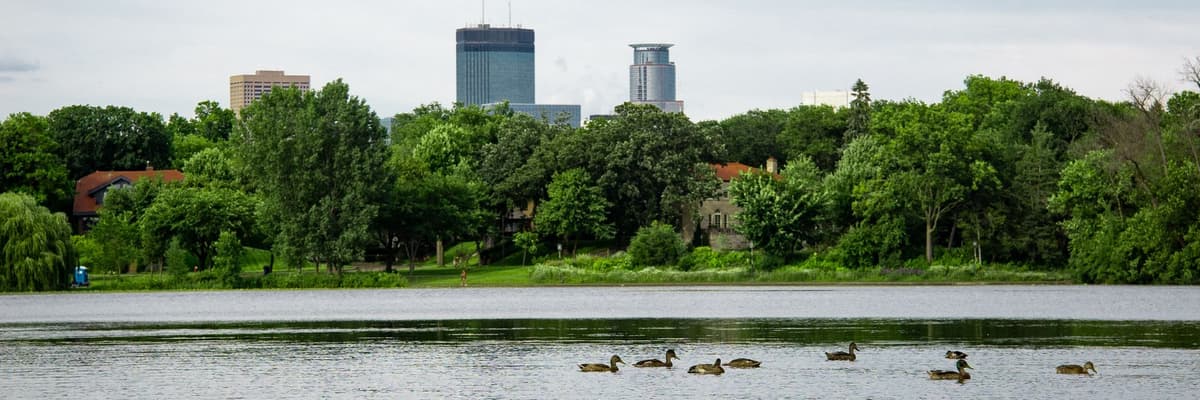
Two Minneapolis, Minnesota towers rising above green trees on the far shore of a city lake, with ducks on the water. The photograph opens the ranking of PsyD programs in Minnesota.

By APA area of accreditation, that is 2 counseling and 1 clinical programs. Every one is at a private institution.

Minnesota’s state exam is the Professional Responsibility Examination, an at-home, open-book test of the rules of conduct, and its postdoctoral year of at least 1,800 hours follows an internship of the same length. Pay here runs above the national median: BLS reports $107,030 for clinical and counseling psychologists in Minnesota, against $100,580 nationwide (May 2025).

PsyD Programs in Minnesota at a Glance

  • Three PsyD programs in Minnesota are ranked. Each holds current APA accreditation and takes new students, and the highest-ranked of them stands 9th nationally. How the programs are scored.
  • Minnesota asks for 1,800 internship hours and 1,800 more after the doctorate. APA accreditation is one way to meet the degree rules, and the state exam is an open-book test on the rules of conduct.
  • Clinical and counseling psychologists in Minnesota earn a median of $107,030. That is BLS pay for SOC 19-3033 in May 2025, with the 10th to 90th percentile running from $62,290 to $163,610.
  • Listed yearly tuition has a median of $29,400. That is across the three programs that list a yearly figure.

Top PsyD Programs in Minnesota

All three ranked PsyD programs in Minnesota, in order. The number on each card is its place in Minnesota, and its national rank is beside the school.

Rank 2

Saint Mary's University of Minnesota’s Psy.D. program page in Counseling Psychology

Minneapolis, MN · Counseling Psychology · No. 79 nationally · On campus

48.7

$29,400
first-year cohort, 2026-2027
56%
50 first-time takers
76%
64 of 84 applicants
5
2025-2026 graduates

Factor scores, out of 10

  • Cost 6.2
  • Earnings 3.7
  • Completion 2.3
  • Outcomes 3.3
  • Track record 5.7
  • Credential 10.0
  • Reputation 4.8

Saint Mary's University of Minnesota's practitioner-scholar Psy.D. in Counseling Psychology requires a mental health-related master's degree for standard admission and schedules its classes on Wednesday and Thursday afternoons and evenings.

Read More on Saint Mary's University of Minnesota Show less on Saint Mary's University of Minnesota

Saint Mary's Psy.D. in Counseling Psychology is based on a practitioner-scholar model with two primary aims: graduates committed to the pursuit of social justice who promote well-being across the lifespan, and counseling psychologists who practice ethically with cultural humility and self-reflection. The 87-credit program is designed to be completed in no less than five years, because coursework must be taken in sequential order and requirements such as practicum, a qualifying exam, a dissertation proposal, individualized mentorship, a clinical case presentation and the dissertation have prerequisites. Students take the most credits in the first two years, spend 15 to 24 hours a week at practicum sites in years two and three, and complete a full-time internship in the fifth year, which may require relocation. The program has no formal areas of specialization, but students choose at least 10 elective credits across Diverse Populations, Diverse Settings, and Advanced Practice and Research.

Applicants need a master's degree in a mental health-related area with at least a 3.4 grade point average and a clinical practicum of at least 300 hours, although students with a bachelor's degree in psychology can seek direct admission and complete the master's and doctorate together in as few as six years; GMAT and GRE scores are not required. Classes begin each September, applications are due January 15, and selected applicants interview with a program administrator. Saint Mary's lists the program as on campus, with classes on Wednesday and Thursday afternoons and evenings; the program does not offer paid research assistantships, though the university lists scholarships for students whose employer is part of its Trusted Partnership Program. Saint Mary's notes that psychologist licenses in Minnesota are granted by the Minnesota Board of Psychology.

  • The program totals 87 credits.
  • Classes meet on Wednesday and Thursday afternoons and evenings.
  • Students spend 15 to 24 hours a week at practicum sites in years two and three.
  • The fifth year is a full-time internship.
  • GMAT and GRE scores are not required.
APA area
Counseling Psychology
Program unit
Psy.D. in Counseling Psychology
APA number
2045
Accredited since
November 6, 2015
Next site visit
2031
Entry
bachelor's or master's degree
GRE
not required
Length
five years, with a full-time internship in the fifth year
Credits
87 credits
Tuition, full-time
$29,400 (first-year cohort, 2026-2027)
University fees
$700
EPPP
56% of 50 first-time takers passed (ASPPB)
Internship match
64 of 84 applicants matched to an APA- or CPA-accredited internship (APPIC)

Scored under methodology v2.0

Sources: APA record of Saint Mary's University of Minnesota (Counseling Psychology), ASPPB, APPIC and APA disclosure of Saint Mary's University of Minnesota (Counseling Psychology), read October 14, 2026.

Rank 3

Augsburg University’s Psy.D. program page in Clinical Psychology

Minneapolis, MN · Clinical Psychology · No. 86 nationally · On campus

46.3

$42,700
first-year cohort, 2026-2027
85%
11 of 13 applicants
5.7
2025-2026 graduates

Factor scores, out of 10

  • Cost 3.3
  • Completion 1.4
  • Outcomes 6.5
  • Track record 2.5
  • Credential 10.0
  • Reputation 2.4

Augsburg University's Psy.D. in Minneapolis, Minnesota, carries on the former Minnesota School of Professional Psychology's program as a full-time, year-round, on-campus practitioner-scholar degree that students can finish in five or six years.

Read More on Augsburg University Show less on Augsburg University

Augsburg's Doctor of Psychology (PsyD) in Clinical Psychology is a legacy program of the former Minnesota School of Professional Psychology and trains students in the practitioner-scholar model to work as health service psychologists. Graduation requires 98 semester credit hours, including 69 credit hours of core courses, 12 credit hours (two years) of practicum and practicum seminar groups, at least 9 credit hours of general electives and 6 credit hours of dissertation, plus a 2,000-hour internship completed in 12 to 24 months. Students complete assessment and therapy practica, each a placement of 9 to 12 months with a minimum of 600 hours; the assessment practicum comes first, and the therapy practicum most often falls in the third year. Every student also passes the Clinical Competency Examination, a series of competency-based clinical tasks, and writes a dissertation with a faculty committee, and the program requires two courses specifically on working with under-resourced populations.

Applicants need a bachelor's degree with an undergraduate or graduate GPA of at least 3.25, five foundation courses completed with a B- or better, and an interview with a member of the admissions committee; GRE scores are optional. The program is full-time, year-round and on campus in Minneapolis, Minnesota, accepts up to 30 credit hours of transfer credit from earlier graduate courses, and typically enrolls a cohort in the low 20s. Teaching assistantships open to students after the first year, and new students may be considered for the PsyD Dean's Scholarship and the PsyD Silver Award.

  • The program requires 98 semester credit hours plus a 2,000-hour internship.
  • Each assessment and therapy practicum requires a minimum of 600 hours.
  • The program can be completed in five or six years.
  • GRE scores are an optional part of the application.
  • Teaching assistantships are available after the first year of the program.
APA area
Clinical Psychology
Program unit
Clinical Psychology
APA number
2445
Accredited since
December 8, 2021
Next site visit
2035
Schedule
full-time
Entry
bachelor's degree
GRE
optional
Length
five or six years
Credits
98 semester credits
Tuition, full-time
$42,700 (first-year cohort, 2026-2027)
University fees
$379
Internship match
11 of 13 applicants matched to an APA- or CPA-accredited internship (APPIC)

Scored under methodology v2.0
Sources: APA record of Augsburg University (Clinical Psychology), APPIC and APA disclosure of Augsburg University (Clinical Psychology), read October 14, 2026.

The Numbers Behind the Minnesota Ranking

The figures below come from the three PsyD programs in Minnesota that this ranking includes, each read from the source named beside it.

  • 3

    APA-accredited PsyD programs ranked in Minnesota

    APA directory
  • 77%

    Median accredited internship match rate across 3 programs

    APPIC
  • $29,400

    Median yearly tuition across 3 programs

    Program disclosures

ASPPB reports first-time EPPP pass rates of 68% for University of St. Thomas and 56% for Saint Mary's University of Minnesota.

The three programs with at least 10 APPIC registrations from 2021 to 2025 matched 76% to 85% of their registered applicants with APA- or CPA-accredited internships, with a median of 77%.

Three programs list a yearly tuition, from $27,692 to $42,700, with a median of $29,400. Each figure is the full-time yearly tuition in the program’s own cost table.

ASPPB adds its own caution: “Please note that care should be exercised if comparisons across schools and programs are made.”

Psychologist Licensure in Minnesota

A PsyD is a degree, and the license comes from the state. These are the rules a graduate of PsyD programs in Minnesota meets for a license there, each linked to the page it was read on.

Licensing questionMinnesota’s answer
Doctoral degree and accreditation
A doctorate with a major in psychology from a regionally accredited institution that meets the board’s rulesA program APA-accredited at graduation meets those rules outright. Graduates of other programs document coursework, in-person residency and the predoctoral internship against Minnesota Rules, part 7200.1300. Source: Minnesota Statutes 148.907, read October 21, 2026
Predoctoral internship
At least 1,800 hours, as part of the degreeAn internship accredited by APA, or one in an APPIC member program, satisfies the rule. Source: Minnesota Rules, part 7200.1300, read October 21, 2026
Postdoctoral supervised employment
One full year after the degree, at least 1,800 hours of actual workInternships, practica and other training done for the degree do not count. The board’s rule allows 12 to 30 months to log the hours, and the statute allows up to 60. Source: Minnesota Rules, part 7200.2000, read October 21, 2026
Licensing examinations
The EPPP and the Minnesota Professional Responsibility Exam (PRE)The PRE tests the rules of conduct in the Psychology Practice Act and has been an at-home, open-book exam since January 2, 2020. Source: Minnesota Board of Psychology, licensure exams page, read October 21, 2026

Licensing board: Minnesota Board of Psychology.

Psychologist Pay in Minnesota

BLS counts 1,290 clinical and counseling psychologists in Minnesota, with a median annual wage of $107,030. School psychologists number 1,060 at a median of $85,190.

Clinical and Counseling Psychologists in Minnesota

$107,030

Median annual pay for clinical and counseling psychologists in Minnesota

  • BLS OEWS, May 2025
10th percentile
$62,290
25th percentile
$80,960
75th percentile
$131,030
90th percentile
$163,610

Occupation: Clinical and Counseling Psychologists, SOC 19-3033.BLS counts 1,290 employed in Minnesota.

Clinical and Counseling Psychologists Pay by Area in Minnesota

Median annual pay for clinical and counseling psychologists in Minnesota and its metropolitan and nonmetropolitan areas, BLS May 2025
AreaMedian annual pay
Minnesota statewide 1,290 employed $107,030
La Crosse-Onalaska, WI-MN 50 employed $126,960
Rochester, MN 110 employed $123,870
Mankato, MN 40 employed $116,320
Fargo, ND-MN $116,130
Minneapolis-St. Paul-Bloomington, MN-WI 910 employed $108,480
St. Cloud, MN 50 employed $107,030
Duluth, MN-WI 70 employed $98,020

School Psychologists in Minnesota

$85,190

Median annual pay for school psychologists in Minnesota

  • BLS OEWS, May 2025
10th percentile
$61,530
25th percentile
$74,410
75th percentile
$101,630
90th percentile
$113,330

Occupation: School Psychologists, SOC 19-3034.BLS counts 1,060 employed in Minnesota.

School Psychologists Pay by Area in Minnesota

Median annual pay for school psychologists in Minnesota and its metropolitan and nonmetropolitan areas, BLS May 2025
AreaMedian annual pay
Minnesota statewide 1,060 employed $85,190
Minneapolis-St. Paul-Bloomington, MN-WI 780 employed $87,510
Rochester, MN 40 employed $84,870
Southeast Minnesota nonmetropolitan area 70 employed $84,090
Northwest Minnesota nonmetropolitan area 60 employed $83,740
Duluth, MN-WI 50 employed $78,770
La Crosse-Onalaska, WI-MN 40 employed $77,870
Fargo, ND-MN 40 employed $63,280

Percentiles are points in each occupation’s pay distribution, not experience levels. BLS lists an area in every state its counties reach, so a metropolitan area that crosses a state line appears under each state.

Questions About a PsyD in Minnesota

Which Is the Best PsyD Program in Minnesota?

In the 2027 ranking, University of St. Thomas in Minneapolis, Minnesota is first among the PsyD programs in Minnesota, with a score of 73.1 out of 100 and 9th place nationally. Its program page is University of St. Thomas’ Doctor of Psychology page in Counseling Psychology. The score weighs cost, graduate earnings, completion, internship and licensure outcomes, track record, credential alignment and program reputation, and the methodology page shows each weight.

What Does a PsyD Cost in Minnesota?

Three ranked programs in Minnesota list a yearly tuition, from $27,692 to $42,700, with a median of $29,400. Each figure is the full-time yearly tuition in the program’s own cost table. A program card labels its tuition figure with the period and rate its school printed, and Read More lists the in-state and out-of-state prices where the cost table gives both.

Does Minnesota Require an APA-Accredited PsyD?

No. The statute asks for a doctorate with a major in psychology from a regionally accredited institution, and Minnesota Rules, part 7200.1550 counts APA accreditation at graduation as meeting the education rules. Graduates of other programs can still qualify: the board’s psychologist FAQ has them document coursework, residency and the predoctoral internship.

How Many Supervised Hours Does Minnesota Require for Psychologists?

Two blocks of 1,800. The degree itself takes a 1,800-hour predoctoral internship, and licensure then takes at least 1,800 hours of postdoctoral employment with at least an hour of scheduled supervision each week. Work that was part of the degree, such as the internship or a practicum, does not count toward the second block.

What Is the Minnesota Professional Responsibility Exam?

It is Minnesota’s jurisprudence exam. According to the board, the PRE covers the Rules of Conduct in the Psychology Practice Act, and since January 2, 2020 candidates take it at home with their books open. The other exam is the EPPP, and the board names Part 1 as the national exam it requires.

What Do Psychologists Earn in Minnesota?

BLS reports a median annual wage of $107,030 for clinical and counseling psychologists (SOC 19-3033) in Minnesota for May 2025. The 10th percentile is $62,290 and the 90th is $163,610. School psychologists (SOC 19-3034) have a median of $85,190. Percentiles mark points in the pay distribution of everyone in the occupation, not years of experience.

Sources for Minnesota PsyD Programs