Skip to Content
PsyDPrograms

2027 Edition

Find a Program

Best PsyD Programs in District of Columbia (2027)

Both ranked PsyD programs in District of Columbia are in Washington, District of Columbia. On the national list, George Washington University in Washington, District of Columbia stands 35th with 63.2 out of 100, the highest score among PsyD programs in District of Columbia.

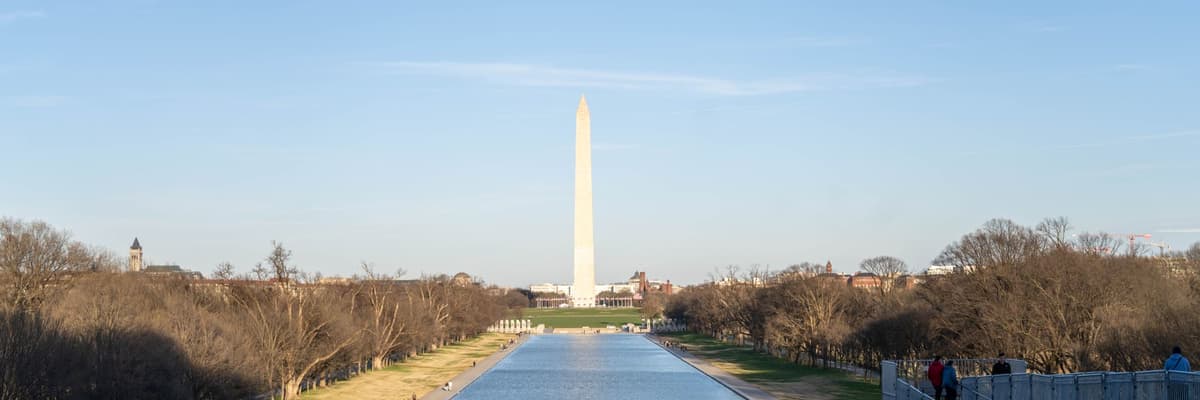
The Washington Monument standing at the end of the Reflecting Pool, framed by bare trees on the National Mall in Washington, DC. The photograph opens the ranking of PsyD programs in District of Columbia.

Both are clinical psychology programs in APA’s accreditation list. Both are at private institutions.

The District’s board has asked applicants by examination since January 1, 2022 to pass both parts of the EPPP, the knowledge exam and the skills exam. Pay here runs above the national median: BLS reports $107,000 for clinical and counseling psychologists in District of Columbia, against $100,580 nationwide (May 2025). School psychologists earn more, at $107,500.

PsyD Programs in District of Columbia at a Glance

  • Two PsyD programs in District of Columbia are ranked. Each holds current APA accreditation and takes new students, and the highest-ranked of them stands 35th nationally. How the programs are scored.
  • The District asks for 4,000 hours of psychological practice experience and both parts of the EPPP. APA accreditation is one of four routes for the doctorate.
  • Clinical and counseling psychologists in District of Columbia earn a median of $107,000. That is BLS pay for SOC 19-3033 in May 2025, with the 10th to 90th percentile running from $70,400 to $324,950.

Top PsyD Programs in District of Columbia

Both ranked PsyD programs in District of Columbia, in order. The number on each card is its place in District of Columbia, and its national rank is beside the school.

Rank 1

George Washington University’s Psy.D. doctoral program in Clinical Psychology

Washington, DC · Clinical Psychology · No. 35 nationally

63.2

$70,132
first-year cohort, 2025-2026
70%
97 first-time takers
83%
90 of 108 applicants
4
2025-2026 graduates

Factor scores, out of 10

  • Cost 0.0
  • Earnings 7.6
  • Completion 8.8
  • Outcomes 6.0
  • Track record 6.6
  • Credential 10.0
  • Reputation 9.0

George Washington University's PsyD in Washington, DC, is built on depth psychology from a psychoanalytic lens, trains every student in the program's own Center Clinic for the first two years and asks each to specialize in a child and adolescent, adult or assessment track.

Read More on George Washington University Show less on George Washington University

GW's Doctor of Psychology (PsyD) in Clinical Psychology trains students in the practitioner-scholar model, and its academic and clinical core is depth psychology from a psychoanalytic lens: coursework covers basic and advanced psychodynamic theory and practice and the history of psychoanalysis, including a year-long Theories of Mind class and a two-semester Psychodynamic Psychotherapy sequence, alongside three semesters of assessment training. Students specialize in one of three tracks (child and adolescent, adult, or assessment) and complete at least 83 credits, a comprehensive exam and a Major Area Paper, a clinical-theoretical paper built on a case from their own experience. Practicum runs through each year of study: all students train in the program's Center Clinic for their first two years, then either continue there or move to externships at program-approved sites such as counseling centers, hospitals, community mental health centers and group practices, and the degree ends with a full-time, 12-month internship at an approved institution. Students take either an accelerated three-year sequence or four years of study before the internship, and all degree requirements must be met within five years of matriculation.

Applicants are judged partly on their fit with the program's psychodynamic and psychoanalytic orientation and attention to sociocultural concerns; a psychology degree is not required, prerequisite courses are recommended rather than required, the GRE general test is optional, and applications are due December 1, with applicants rated a good fit invited to an orientation and interview with faculty. Up to 27 graduate transfer credits may be approved case by case, though they do not reduce the number of semesters of training. A reduced-load option drops one course each fall and spring semester so coursework spreads over four years, and students on it are still considered full-time. The program offers limited funding to some incoming students, including merit scholarships for which all applicants are considered and teaching assistant roles typically for advanced students, but no full-tuition graduate assistantships, and incoming PsyD students may be eligible for Columbian College's partial-tuition Dean's Award.

  • The program requires at least 83 credits.
  • Students specialize in one of three tracks: child and adolescent, adult, or assessment.
  • All students train in the program's Center Clinic for their first two years.
  • The GRE general test is optional.
  • All degree requirements must be completed within five years of matriculation.
APA area
Clinical Psychology
Program unit
Professional Psychology Program
APA number
1092
Accredited since
February 16, 2001
Next site visit
2034
Schedule
full-time
GRE
optional
Length
three or four years of study, then a full-time, 12-month internship, all within five years of matriculation
Credits
83 credits
Tuition, full-time
$70,132 (first-year cohort, 2025-2026)
University fees
$486
EPPP
70.1% of 97 first-time takers passed (ASPPB)
Internship match
90 of 108 applicants matched to an APA- or CPA-accredited internship (APPIC)

Scored under methodology v2.0

Sources: APA record of George Washington University (Clinical Psychology), ASPPB, APPIC and APA disclosure of George Washington University (Clinical Psychology), read October 12, 2026.

Rank 2

The Chicago School, Washington, D.C. Campus (doctorate page for the Clinical Psychology Psy.D. program)

Washington, DC · Clinical Psychology · No. 78 nationally · On campus

49.1

$62,007
first-year cohort, 2026-2027
49%
246 first-time takers
83%
223 of 270 applicants
5.2
2025-2026 graduates

Factor scores, out of 10

  • Cost 0.4
  • Earnings 5.6
  • Completion 5.3
  • Outcomes 3.8
  • Track record 9.9
  • Credential 10.0
  • Reputation 3.5

The Chicago School's Psy.D. Clinical Psychology program in Washington, D.C., offers emphases in forensic psychology, clinical neuropsychology, clinical health psychology and clinical child and adolescent psychology, and is affiliated with the APA-accredited Mid Atlantic Internship Consortium.

Read More on The Chicago School, Washington, D.C. Campus Show less on The Chicago School, Washington, D.C. Campus

The Psy.D. Clinical Psychology at The Chicago School's Washington, D.C., campus follows the practitioner-scholar model, and the department does not advocate any single theoretical orientation: students take a basic intervention course in all four intervention orientations, then advanced intervention coursework in their third year. The 104-credit-hour program is planned as four years of coursework followed by a full-time internship, with a 600-hour practicum in each of years two, three and four; the first practicum sequence centers on psychological assessment and the second on psychotherapy. Every student passes a Clinical Competency Examination and completes a dissertation, and the internship requires at least 2,000 hours over 12 to 24 months; the campus is affiliated with the Mid Atlantic Internship Consortium, through which students have the opportunity to complete their internship.

Applicants need a bachelor's degree from an accredited institution and 18 hours of psychology credit with grades of C or better, including child or human development (or lifespan), abnormal psychology and statistics; applicants invited to interview typically have an undergraduate GPA of 3.2 or higher, and interviews are by invitation only. Classes are on the ground in Washington, D.C., and the program is designed for five years of full-time study, with all degree requirements due within seven academic years. Students may elect an emphasis in forensic psychology, clinical neuropsychology, clinical health psychology or clinical child and adolescent psychology, each built from electives and practica at related training sites. The school's Clinical Psychology Impact Fellowship awards five full-tuition fellowships, one to a new, incoming student at each Psy.D. Clinical Psychology location, and the school says the program is designed to meet the educational requirements for clinical psychologist licensure; licensure itself is granted by each state's psychology board.

  • The program totals 104 credit hours.
  • Students complete a 600-hour practicum in each of years two, three and four.
  • The internship requires at least 2,000 hours over 12 to 24 months.
  • Students may elect an emphasis in forensic psychology, clinical neuropsychology, clinical health psychology or clinical child and adolescent psychology.
  • The program is affiliated with the APA-accredited Mid Atlantic Internship Consortium.
APA area
Clinical Psychology
Program unit
Clinical Psychology Psy.D. Program
APA number
2055
Accredited since
December 3, 2015
Next site visit
2034
Schedule
full-time
Entry
bachelor's degree
Length
five academic years: four years of coursework followed by a full-time internship
Credits
104 credit hours
Tuition, full-time
$62,007 (first-year cohort, 2026-2027)
University fees
$3,158
EPPP
48.78% of 246 first-time takers passed (ASPPB)
Internship match
223 of 270 applicants matched to an APA- or CPA-accredited internship (APPIC)

Scored under methodology v2.0

Sources: APA record of The Chicago School, Washington, D.C. Campus (Clinical Psychology), ASPPB, APPIC and APA disclosure of The Chicago School, Washington, D.C. Campus (Clinical Psychology), read October 14, 2026.

The Numbers Behind the District of Columbia Ranking

The figures below come from the two PsyD programs in District of Columbia that this ranking includes, each read from the source named beside it.

  • 2

    APA-accredited PsyD programs ranked in District of Columbia

    APA directory
  • 35th

    Highest national rank among PsyD programs in District of Columbia

    This ranking

ASPPB reports first-time EPPP pass rates of 70% for George Washington University and 49% for The Chicago School, Washington, D.C. Campus.

APPIC’s 2021 to 2025 match data put the accredited internship match rate at 83% for George Washington University and 83% for The Chicago School, Washington, D.C. Campus.

Yearly tuition is $70,132 at George Washington University and $62,007 at The Chicago School, Washington, D.C. Campus. Each figure is the full-time yearly tuition in the program’s own cost table.

ASPPB adds its own caution: “Please note that care should be exercised if comparisons across schools and programs are made.”

Psychologist Licensure in District of Columbia

A PsyD is a degree, and the license comes from the state. These are the rules a graduate of PsyD programs in District of Columbia meets for a license there, each linked to the page it was read on.

Licensing questionDistrict of Columbia’s answer
Doctoral degree and accreditation
A doctorate from an institution with recognized accreditation, through one of four program routesThe routes are a program APA-accredited when the degree was awarded, a program on the ASPPB and National Register designation list, a degree conferred before 1981, or an active ABPP diploma. Source: 17 DCMR 6902, read October 21, 2026
Supervised experience
4,000 hours of psychological practice experienceA predoctoral internship can supply up to 2,000, with the remainder finished within two years of the degree. All 4,000 can also be earned after the degree, over two to three years. Source: 17 DCMR 6902, read October 21, 2026
National examination
The EPPP, at a score no lower than half a standard deviation below the national mean Source: 17 DCMR 6904, read October 21, 2026
EPPP Part 2 (Skills)
Required by board policy for applicants by examination or re-examination applying on or after January 1, 2022The board reads its national examination rule as covering both parts of the EPPP. Source: DC Board of Psychology, Policy Statement 21-002, read October 21, 2026
Jurisprudence
Required by regulation, and met for now by reading the board’s study material and signing an attestation form Source: DC Board of Psychology, new license checklist by examination, read October 21, 2026

Licensing board: District of Columbia Board of Psychology.

Psychologist Pay in District of Columbia

BLS counts 220 clinical and counseling psychologists in District of Columbia, with a median annual wage of $107,000. School psychologists number 250 at a median of $107,500.

Clinical and Counseling Psychologists in District of Columbia

$107,000

Median annual pay for clinical and counseling psychologists in District of Columbia

  • BLS OEWS, May 2025
10th percentile
$70,400
25th percentile
$85,810
75th percentile
$132,300
90th percentile
$324,950

Occupation: Clinical and Counseling Psychologists, SOC 19-3033.BLS counts 220 employed in District of Columbia.

School Psychologists in District of Columbia

$107,500

Median annual pay for school psychologists in District of Columbia

  • BLS OEWS, May 2025
10th percentile
$83,470
25th percentile
$96,560
75th percentile
$136,940
90th percentile
$164,380

Occupation: School Psychologists, SOC 19-3034.BLS counts 250 employed in District of Columbia.

Percentiles are points in each occupation’s pay distribution, not experience levels. BLS lists an area in every state its counties reach, so a metropolitan area that crosses a state line appears under each state.

Questions About a PsyD in District of Columbia

Which Is the Best PsyD Program in District of Columbia?

In the 2027 ranking, George Washington University in Washington, District of Columbia is first among the PsyD programs in District of Columbia, with a score of 63.2 out of 100 and 35th place nationally. Its program page is George Washington University’s Doctor of Psychology page in Clinical Psychology. The score weighs cost, graduate earnings, completion, internship and licensure outcomes, track record, credential alignment and program reputation, and the methodology page shows each weight.

Does DC Require an APA-Accredited PsyD?

No. The regulation accepts a program APA-accredited when the degree was awarded, but also a program on the ASPPB and National Register designation list, a degree conferred before 1981, or an active ABPP diploma. Whichever route applies, the school itself must be accredited by a recognized accrediting body.

Does DC Require EPPP Part 2?

Yes, for applicants by examination or re-examination applying on or after January 1, 2022. In its 2021 policy statement the board reads the national examination rule as covering both parts. Its 2023 guidance lets applicants who have finished 2,000 predoctoral hours and are at least ten months into a postdoctoral fellowship apply early, and the board then authorizes Part 1 at once.

Is There a DC Jurisprudence Exam for Psychologists?

The regulation requires one, on District law and the ethics of practice. For now, the board’s application checklist says there is no DC exam to sit: applicants read the board’s study material and sign an attestation statement instead.

What Do Psychologists Earn in District of Columbia?

BLS reports a median annual wage of $107,000 for clinical and counseling psychologists (SOC 19-3033) in District of Columbia for May 2025. The 10th percentile is $70,400 and the 90th is $324,950. School psychologists (SOC 19-3034) have a median of $107,500. Percentiles mark points in the pay distribution of everyone in the occupation, not years of experience.

Sources for District of Columbia PsyD Programs